Wolfgang Hieronymus von Bömmel
- Born
- 1667
- Active
- 1660–1700
- Period
- Baroque
- Nationality
- German
Biography
Almost nothing is recorded of Bömmel's life. No birth or death dates survive, and he is known almost entirely through his prints. Museum records place his activity in Nuremberg in the decades around 1660–1700, and his name appears in variant spellings, including Bemmel.
Nuremberg was then one of the leading centers of goldsmithing and print publishing in the Holy Roman Empire. Ornament prints were a working tool of that trade: inexpensive sheets that carried new motifs from designer to craftsman and from one workshop to the next. Bömmel worked squarely within this tradition, producing designs meant to be adapted in chased, engraved, or embossed metalwork.
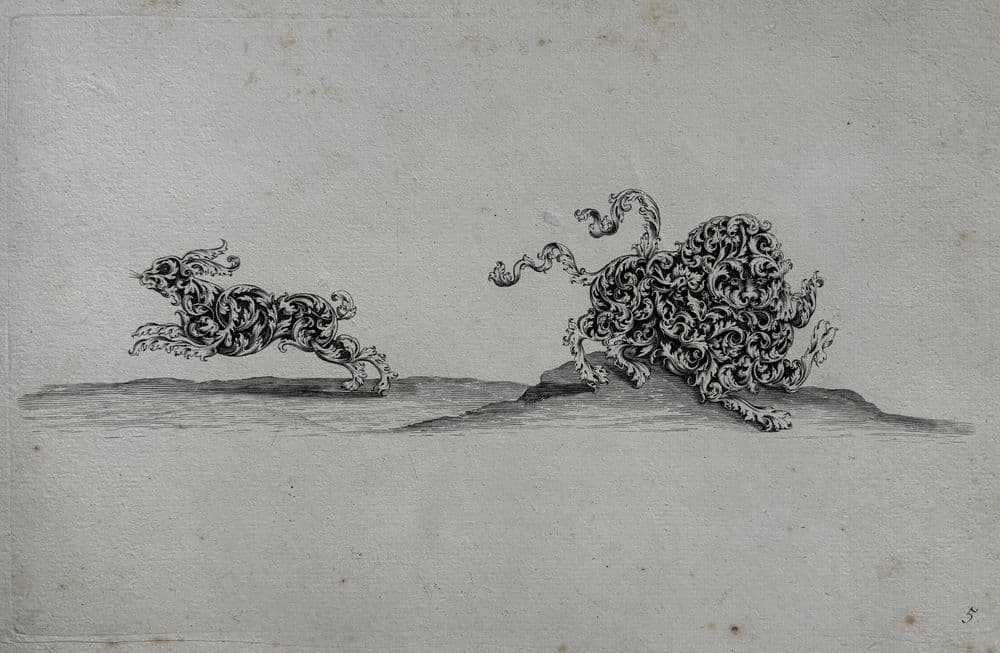
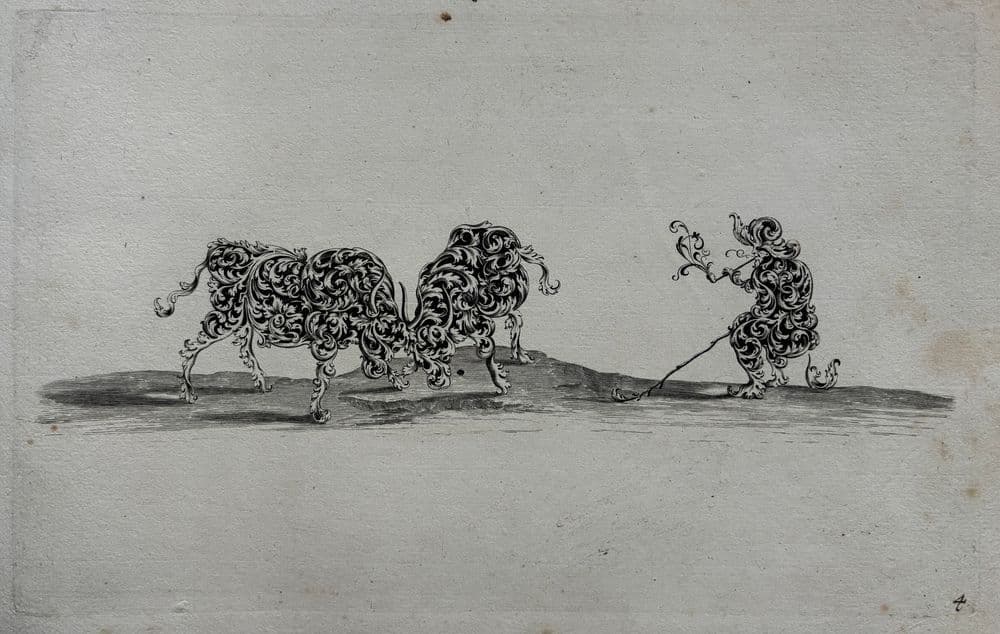
His best-known work is Neu-ersonnene Gold-Schmieds Grillen, with a second part (Ander Theil). Its plates show creatures formed wholly from acanthus scrolls: a hare and a dog, a dog and a goat, a dog and a cat, a horse, and two fighting bulls with a herdsman. Impressions in New York were printed by the Nuremberg engraver and publisher Christoph Weigel around 1700, and other sheets name the publisher Leonhard Loschge.
The scrolling acanthus, inherited from ancient Roman ornament, was an essential part of the goldsmith's repertoire from about the mid-seventeenth to the end of the eighteenth century. Bömmel's contribution was to push the motif toward fantasy, letting foliage take the shape of living animals while still reading as usable pattern.
The suite's reach is shown by its copies. In 1698 Anthonie de Winter published reverse copies in Amsterdam as Nieuw Goudt Smits Lofwerck, and other plates after Bömmel by unidentified engravers also survive. His prints are now held by the Victoria and Albert Museum, the Metropolitan Museum of Art, and the British Museum.