Rembrandt Harmenszoon van Rijn
- Born
- 1606
- Died
- 1669
- Active
- 1625–1669
- Period
- Baroque
- Nationality
- Dutch
Biography
Rembrandt was born in Leiden in 1606, the son of a miller. He attended the Latin school and briefly the university before training as a painter, first with Jacob van Swanenburgh in Leiden and then for six months with the history painter Pieter Lastman in Amsterdam. By the mid-1620s he was working independently in Leiden, often alongside Jan Lievens.
Around 1631 he moved to Amsterdam, where he quickly became the city's most sought-after portraitist. The Anatomy Lesson of Dr Nicolaes Tulp (1632) made his name. In 1634 he married Saskia van Uylenburgh, and in 1639 he bought a large house on the Breestraat, now the Rembrandt House Museum.
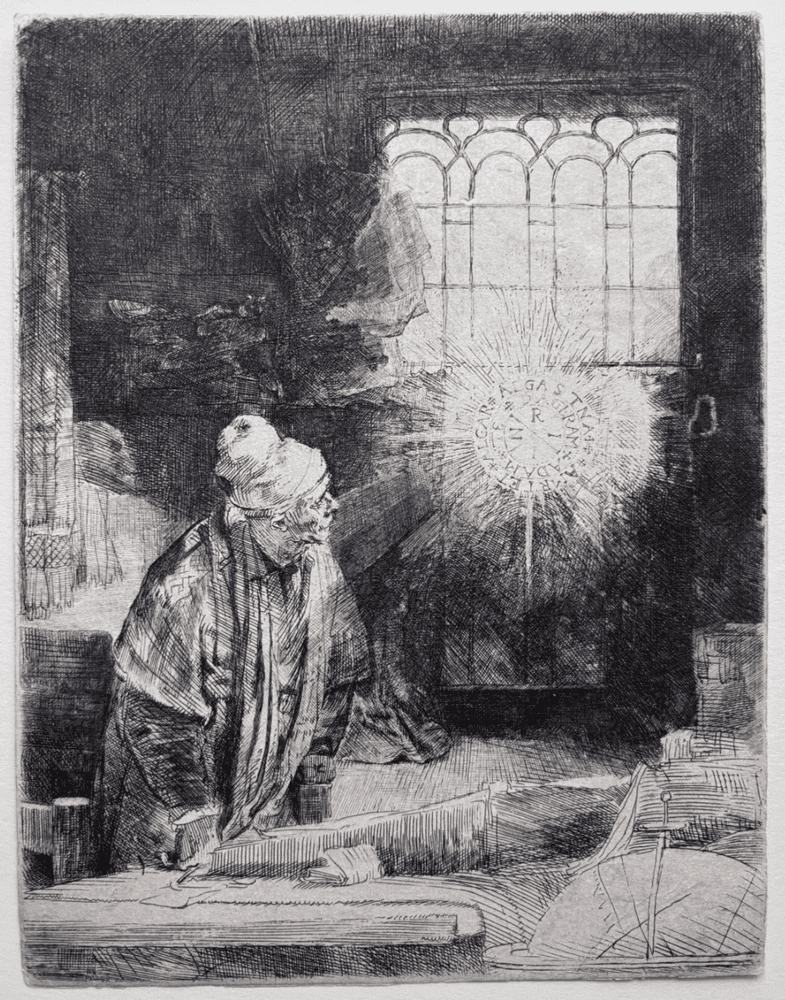
Etching was central to his art from the start. He used the needle with the freedom of a pen, then reworked plates through multiple states, adding drypoint and varying the ink left on the plate. Masterpieces include the Hundred Guilder Print (c. 1648) and The Three Crosses (1653), whose later states radically transform the image.
The 1640s brought personal loss. Saskia died in 1642, the year of The Night Watch, leaving their infant son Titus. Rembrandt later lived with Hendrickje Stoffels. Overextended financially, he was declared insolvent in 1656, and his house and collection were sold.
His late paintings and self-portraits are among the most admired works in Western art. Hendrickje died in 1663 and Titus in 1668. Rembrandt died in Amsterdam in 1669 and was buried in the Westerkerk.