Paul Nash
- Born
- 1889
- Died
- 1946
- Active
- 1910–1946
- Period
- Modern
- Nationality
- British
Biography
Nash was born in London in 1889 and grew up partly in rural Buckinghamshire. He studied at the Slade School of Fine Art in 1910–11, where his contemporaries included Stanley Spencer and Ben Nicholson. His early drawings of trees and ancient sites such as Wittenham Clumps already show the visionary sense of place that runs through his work.
In 1914 he enlisted in the Artists' Rifles, and he served at the Ypres Salient in 1917. Invalided home after an accident, he returned to the front as an official war artist. Works such as We Are Making a New World and The Menin Road turned the shattered landscape into a powerful indictment of the war.
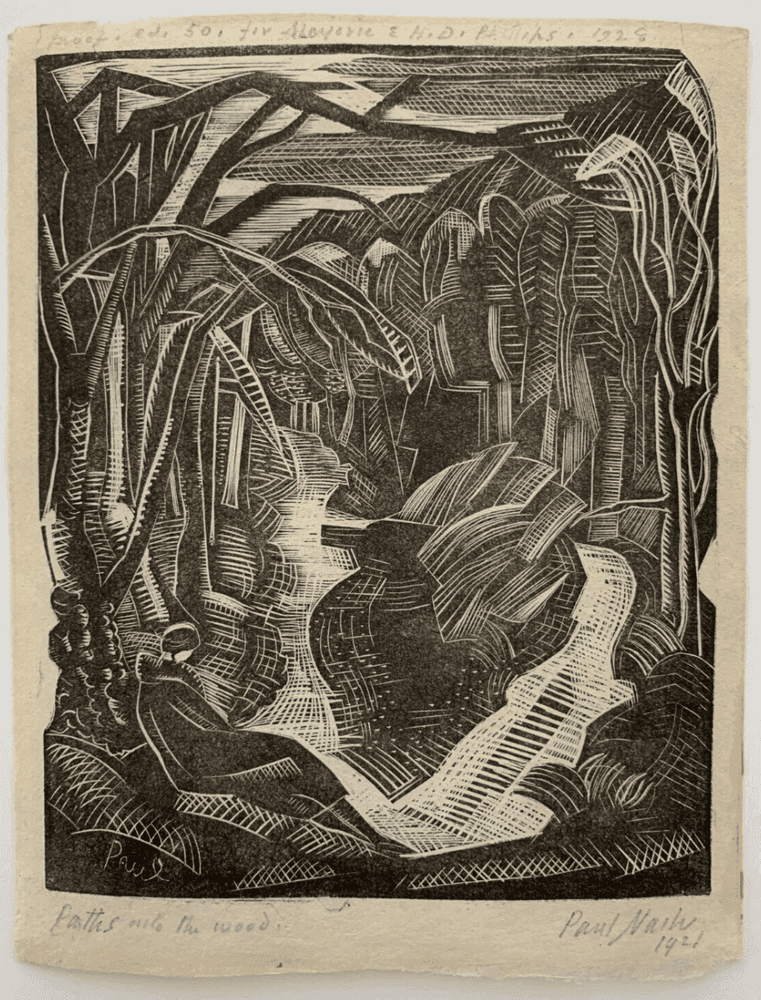
In the 1920s Nash turned to wood engraving and book illustration, producing a celebrated set of abstract designs for Genesis (1924). He also designed textiles and taught at the Royal College of Art. In 1933 he founded Unit One, a group of British avant-garde artists and architects.
In the 1930s his work drew increasingly on Surrealism, and he exhibited in the 1936 International Surrealist Exhibition in London. Found objects, megaliths and dreamlike juxtapositions entered his landscapes. In the Second World War he again served as an official war artist, painting Totes Meer (1940–41), a sea of wrecked German aircraft.
Nash suffered from chronic asthma, and he died in his sleep in 1946 at Boscombe, near Bournemouth. His brother John Nash was also a painter. Paul Nash's work is held by Tate, the Imperial War Museum and the British Museum.