Jacques Villon
- Born
- 1875
- Died
- 1963
- Active
- 1894–1963
- Period
- Modern
- Nationality
- French
Biography
Gaston Duchamp was born in 1875 in Damville, Normandy, into a family that produced four artists. He briefly studied law before turning to art in Paris in the mid-1890s. There he adopted the pseudonym Jacques Villon, after the fifteenth-century poet François Villon, and worked as an illustrator and cartoonist for Parisian journals.
In the 1900s he made a celebrated series of colour etchings and aquatints of fashionable Parisian life, in a style indebted to Toulouse-Lautrec. Around 1910 he turned toward Cubism. His studio in Puteaux became a meeting place for artists such as Albert Gleizes, Jean Metzinger and Fernand Léger, a circle later called the Puteaux Group.
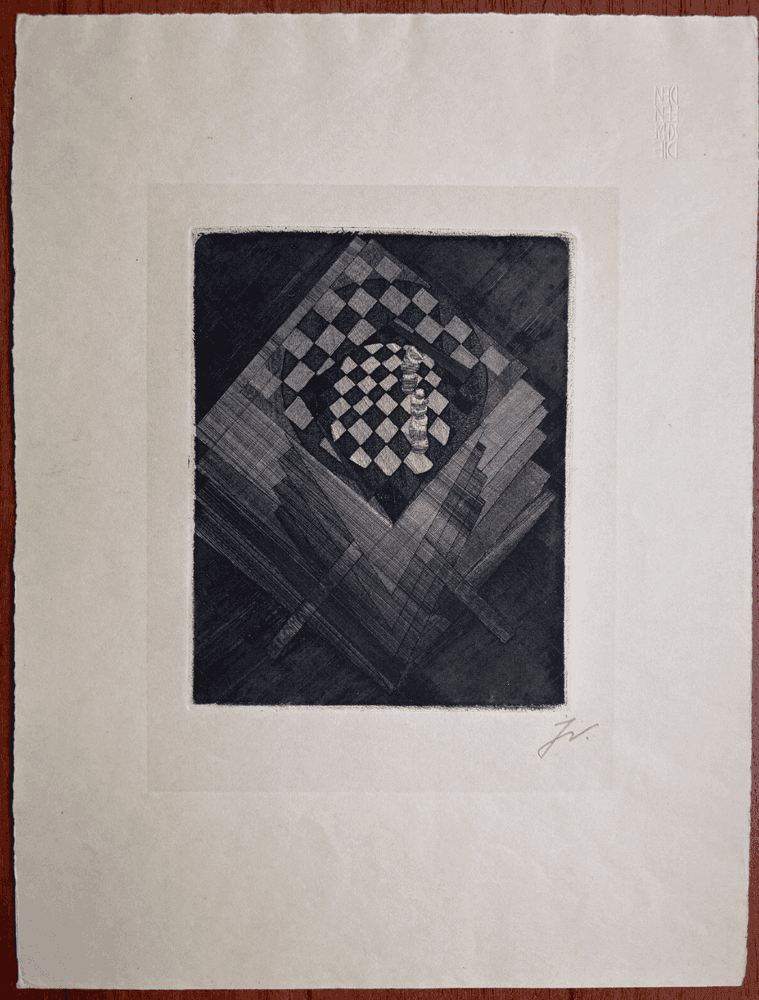
Villon is credited with proposing the name Section d'Or for the group's landmark 1912 exhibition, reflecting his interest in proportion and geometry. In 1913 he exhibited at the Armory Show in New York, where his work sold well. His prints of this period, such as his Cubist portraits, are among the finest of the movement.
After army service in the First World War he struggled for recognition. Through the 1920s he supported himself partly by making colour aquatint reproductions of paintings by modern masters. He continued to develop his own art of prismatic colour planes in painting and printmaking alike.
After the Second World War his reputation rose sharply. He won the Carnegie Prize in 1950 and the Grand Prize for painting at the Venice Biennale in 1956. He died in Puteaux in 1963, the same year as Braque.