Georges Braque
- Born
- 1882
- Died
- 1963
- Active
- 1902–1963
- Period
- Modern
- Nationality
- French
Biography
Braque was born in 1882 in Argenteuil and grew up in Le Havre, where his father and grandfather ran a house-painting and decorating business. He trained as a decorative painter, learning techniques such as imitating wood grain and marble, which later resurfaced in his Cubist work. He moved to Paris around 1902 to study painting.
In 1905–07 he painted in the brilliantly coloured Fauve style. The Paul Cézanne memorial retrospective of 1907 and his first meeting with Picasso the same year turned him toward a new, structural approach. From 1908 the two worked so closely that they compared themselves to roped mountaineers.
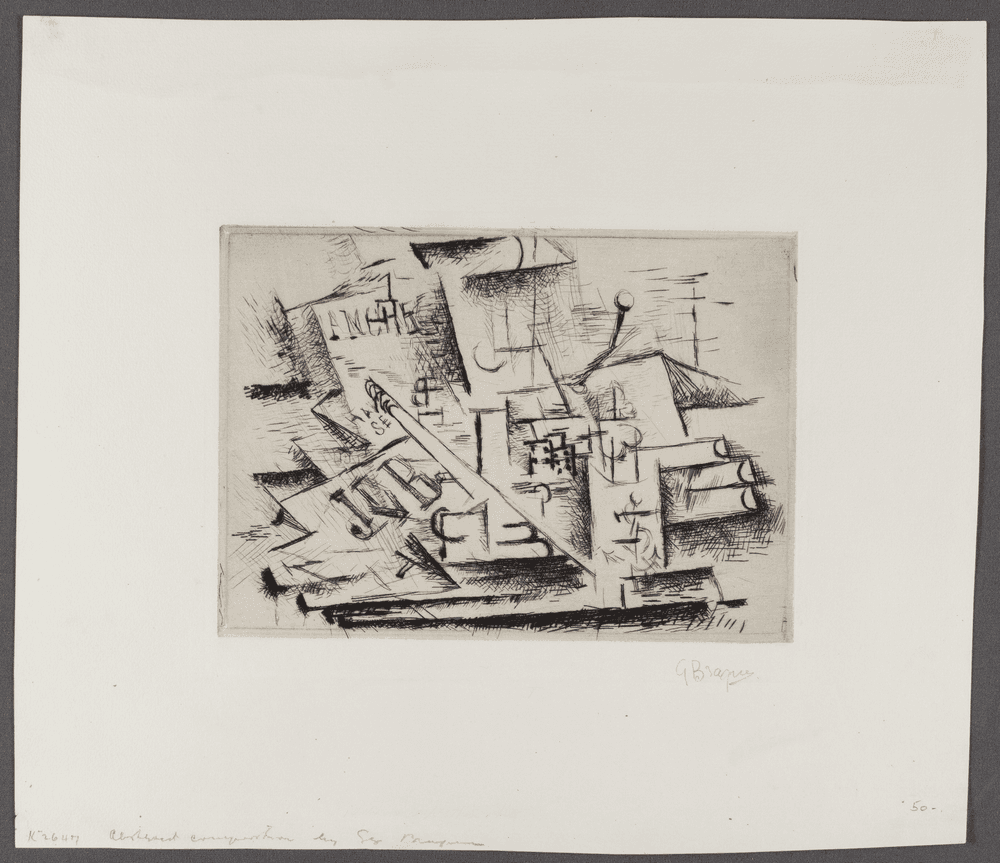
Together they developed analytic Cubism, fragmenting objects into faceted planes, and then synthetic Cubism. In 1912 Braque made the first papier collé, gluing printed wallpaper into a drawing. His early etchings, including Fox and Job (both 1911), are key Cubist prints.
Braque was severely wounded in the head in 1915 and returned to painting only in 1917. The partnership with Picasso did not resume. In the following decades he refined a contemplative art of still lifes, guitars and tables, culminating in the Studio series of 1949–56 and his late images of birds.
In 1953 he painted a ceiling in the Louvre's Henri II room, and in 1961 he became the first living artist given an exhibition at the Louvre. He died in Paris in 1963 and was given a state funeral.